2025 Annual Letter

I hope this finds you and your family doing well!
Wrightsville Beach, North Carolina is named after Joshua Grainger Wright (1758-1811), a state legislator and superior court judge. His descendants were some of the first settlers in Wilmington and instrumental in making it a permanent settlement. The island is full of lore and legend yet its role in The Civil War rises above all. On April 27, 1861, President Abraham Lincoln issued a proclamation declaring a blockade of North Carolina due to the geography and inland accessibility. Lincoln’s plan was to stifle the Confederate economy to help secure victory for the Union. It worked, and the Wilmington and Wrightsville Beach area accounted for a significant amount of the more than 1,100 captured vessels and the 355 ships destroyed or run aground.1
The Wrightsville Beach Museum of History opened in 1996. Its mission is to collect, care for, exhibit and interpret items that serve to illustrate the history of the beach and area. It is a gem hiding in plain sight and is alive with personalities, history books, artifacts and stories still waiting to be told.
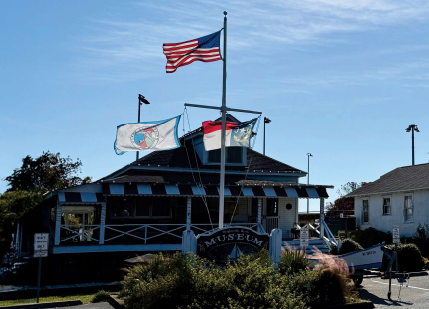
Entry is free and open to the public Thursday through Sunday most of the year. Visit and be sure you pull out the old photo albums showing why the beach was deemed “The Playground of the South”. The museum lives in the Myers Cottage at the Wrightsville Beach Historic Square near Town Hall.
The Myers Cottage was originally built in 1907 by the Wrightsville Beach Suburban Development Company, a subsidiary of the Tidewater Power Company as a strategy to encourage visitors and residential development on the island. Homes showcased the latest modern amenities such as electricity, a kitchen on the same level as the home, ceiling fans, a modern lavatory and floor cutouts to allow water to flow freely during storms and high tides. The wraparound porch is thought to be original to the home as it was included in a fire insurance map from 1910. When you walk up the steps of the museum and stand on the porch, your imagination conjures up family and friends in rocking chairs, enjoying shade and gathering for conversation, laughter and good times.
When you walk in the museum, you are immediately greeted with creaking doors and floors combined with the damp, nostalgic smell of an old beach home steeped in history. The floors are painted a pale blue-green color known as haint blue. The white walls and ceiling are also peeling and revealing the same color. In the early 1800s, the Gullah Geechee people, found in southern coastal communities, started painting floors, walls and ceilings blue. They believed the color repelled evil spirits, known as haints, as they were unable to cross the water or sky hence the name haint blue. If you have ever visited Charleston, South Carolina, you have been at the epicenter of Gullah Geechee traditions which still exists today. Their culture is infused with storytelling, food, art and spirituality.2 Notice the color of floors, walls and ceilings the next time you are around coastal communities from North Carolina to northern Florida. Chances are one of them is painted a shade of blue.
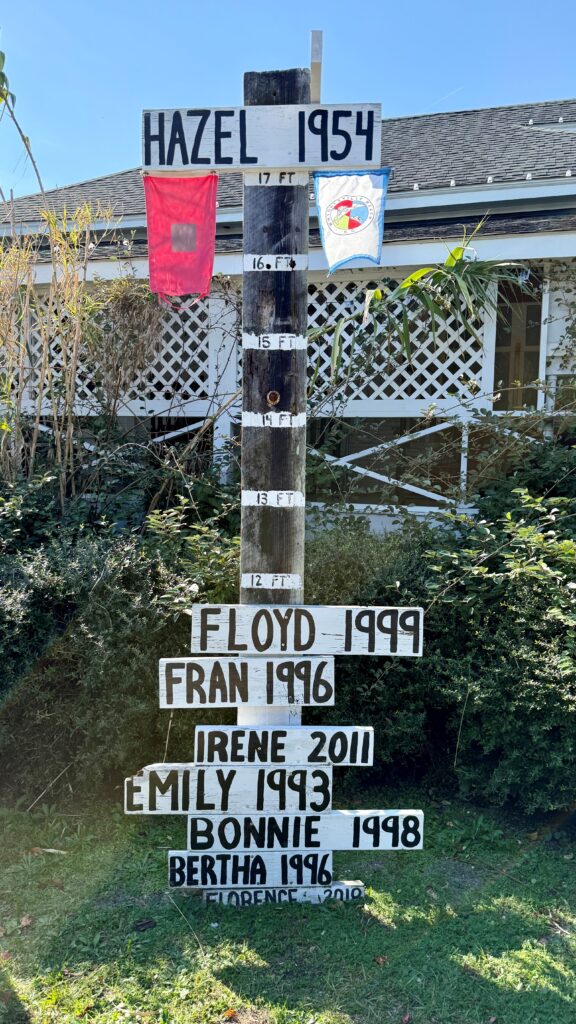
Outside of the Wrightsville Beach Museum of History, and to the left of the front porch, stands a tall pier piling. The piling was salvaged in the 2013 demolition and rebuilding of the east end of Crystal pier. Today, half of the pier is seating for The Oceanic restaurant. At the top of the piling a weathered white rectangle sign reads HURRICANES in black, hand-painted letters. As your eyes move down the piling every 12 inches, white bands mark it with a number and the letters FT behind it. This template continues and labels notable hurricanes and corresponding storm surge at Wrightsville Beach, as measured in feet. The hurricane at the top of the piling reads HAZEL 1954 and in the white band underneath, 17 FT.
An eventual hurricane starts off the western coast of Africa and is termed a tropical wave. It then moves to a tropical disturbance, tropical depression, tropical storm and finally, a hurricane. The World Meteorological Organization (WMO) maintains and updates the official hurricane lists. There are six rotating lists which are reused every six years. On an annual basis, 21 names are designated for the season. Storm names alter between male and female and represent a mix of cultural backgrounds. Once a storm reaches tropical storm strength, winds greater than 39 miles per hour, it becomes a hurricane. The storm then keeps the name throughout its life.3
In 1942, the Navy gave 25 surplus radars to the US Weather Bureau though the radars were not available for national weather warning purposes until 1959.4 Most of the tracking of Hurricane Hazel was left to the Miami office of the U.S. Weather Bureau, now known as the National Weather Service. Grady Norton was the chief weather forecaster, and he had an uncanny ability to analyze and interpret data to make accurate, hurricane landfall targets 24 hours or more in advance. To track Hurricane Hazel, he relied mostly on ship reports sharing news that a storm had formed off the coast of Grenada. On October 9, 1954, tropical storm Hazel intensified and became Hurricane Hazel. The Weather Bureau knew the hurricane had shifted to the west and turned north where the mountains of Haiti interrupted and briefly downgraded it to a tropical storm. Knowing this information, Grady Norton finished his 12-hour shift and went home where he had a stroke and died. With a deadly hurricane on the way and most of the eastern seaboard in its crosshairs, the Weather Bureau had lost its leader.5
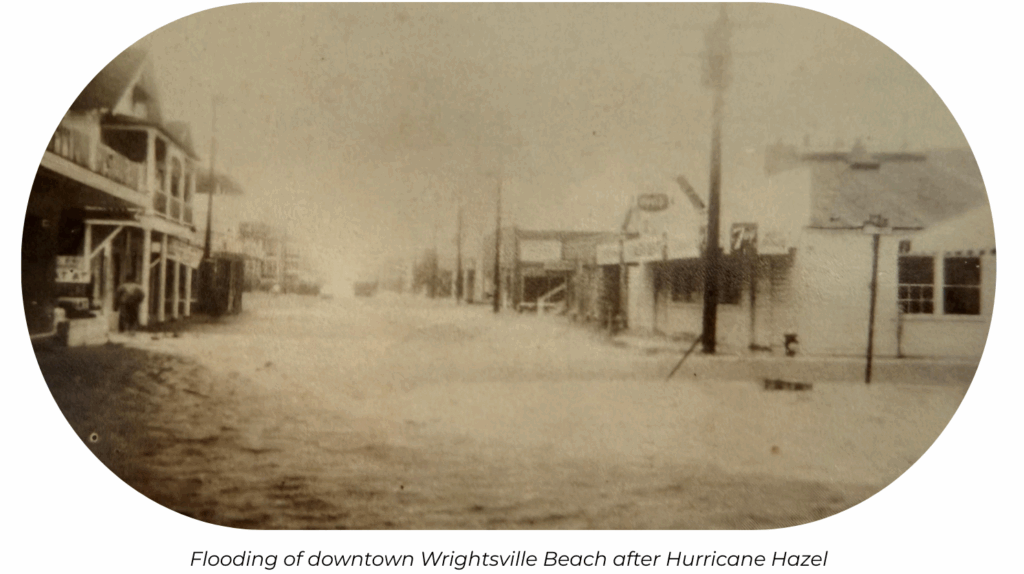
The newspaper was most people’s primary source of information until the television came along in the late 1940’s and early 50’s. On October 14th, 1954, the morning headline for Wilmington’s newspaper read: ‘Hazel’ Kills Haitian Hundreds, Razing Whole Towns In Path. The afternoon headline read: HAZEL MAY STRIKE CAPES AREA TONIGHT. Around 10 a.m. on October 15th, Hurricane Hazel made landfall between Wilmington, North Carolina and Myrtle Beach, South Carolina as a Category 4 Hurricane with winds of 140 miles per hour. Hurricane Hazel’s arrival also coincided with a full moon and the highest lunar tide of the year creating a 17-foot storm surge, the highest ever recorded at Wrightsville Beach.6 Can you imagine what it must have felt like waking up to a storm of such magnitude and not even know it was coming?
Hurricane Hazel left a wake of near total devastation. In Wrightsville Beach, 89 buildings were destroyed and 155 were severely damaged. In Brunswick County’s Long Beach, 357 cottages were on the island before Hurricane Hazel and five severely damaged cottages remained afterwards. In Carolina Beach, 362 buildings were destroyed and 288 suffered major damage. In Topsail Island, 210 of 230 homes were destroyed along with the island’s drawbridge. All of North Carolina’s beaches were significantly impacted and changed forever. Hazel eventually traveled inland between Raleigh and Rocky Mount and moved up today’s Interstate 95 corridor. The hurricane traveled north at 55 miles per hour, taking only six hours to move through North Carolina. Hazel was in Canada in less than a day before ending in Scandinavia. Hurricane Hazel killed at least 600 people with total damage priced at almost $400 million in 1954 dollars.6 If a hurricane becomes especially significant, the name will be retired. Hurricane Hazel is a retired name.3
The Weather Channel launched in 1982. Today, it leads weather coverage in the United States and operates 24/7. The meteorologists along with professionals from the National Hurricane Center (NHC) provide up to the minute coverage and statical analysis from every angle. The Weather Channel’s team are incredible at helping those in a hurricane’s path with preparation and accurately predicting landfall, rainfall, storm surge and the storm’s track. Jim Cantore is the meteorologist who stands out amongst all others as he is always positioned near or at the eye of the storm. One morning in September of 2018, Jim Cantore and The Weather Channel crew were setting up shop underneath Johnnie Mercer’s Fishing Pier at Wrightsville Beach. I walked the beach this particular morning and took a panoramic photo before leaving. To the north the sky was beautiful with a radiant sunrise peeking over the ocean’s horizon. To the south, dark skies and apocalyptic clouds. There was another hurricane on the way and the beach was again in the line of fire.
On September 14, 2018, exactly 64 years and 11 months from Hurricane Hazel, Hurricane Florence made landfall at Wrightsville Beach. Florence was a Category 1 storm with winds of 90 miles per hour and a storm surge of four feet. Though Hurricane Florence was only a Category 1 storm, it churned over southeastern North Carolina for three days and dumped around 30 inches of rain. The major storm surge was further up the coast around New Bern, North Carolina where the Trent River crested at a record 29 feet, a full 17 feet above flood stage, a record still standing today.7 The combination of wind and the ground saturated with water proved a recipe for disaster. Hurricane Florence took 52 lives, 22 direct fatalities caused by the immediate effects of the storm and 30 indirect fatalities occurred in the aftermath. The final damages were estimated to be over $24 billion.8
Wrightsville Beach continues to be a target for hurricanes, tropical storms, nor’easters, high tides and increasing sea levels. New Hanover County, through an occupancy tax paid for by hotel beach guests and other renters, along with the state and federal government maintain funds allocated to protect the beach. The current renourishment program is on a four-year cycle and mostly consists of dredging inlets to pump sand back on the beach and plantings to help protect the shoreline and combat erosion.9
I have lived in eastern and southeastern North Carolina my entire life and have never evacuated for a hurricane. Due to the forecast, I did for Florence. After a week, drivable roads finally opened to travel home. When I arrived in Wilmington, the weather was beautiful, and the sky was a perfect Carolina blue. The rest of the area looked like something out of movie. Uprooted trees, debris, parts of homes and downed power lines were visible everywhere you looked.
I came home to seven trees completely down in my backyard and two more badly damaged. The trees and limbs crisscrossed the backyard, but, thankfully, stayed off my home. I had five healthy trees remaining and three were sabal palms. They have a story. In the summer of 2013, I had an evening meeting at a Client’s home. They have one of the most beautifully landscaped properties you will ever see. Live oaks, azaleas, ferns, palm trees, potted plants, a garden and pool fill their 2-acre property. As our meeting ended, the husband, who is a real-life Cowboy, asked if I wanted any palm trees. Of course, I wanted palm trees! As the Cowboy took me over to the palm trees, I was surprised. The palm trees he was speaking of were shoots off a large palm in his yard that started as a shoot from another palm at Wrightsville Beach. Together, we strategically pulled shoots from the ground. They were roughly 10 inches long. The top half was green and the bottom brown from being in the ground. I came home that night with 15 to 20 sabal palm tree shoots. The next day I purchased miracle grow potting soil and small individual black, plastic pots. All except one shoot went into a pot. I planted the lone shoot in the ground where it would get plenty of sunshine and room to grow.
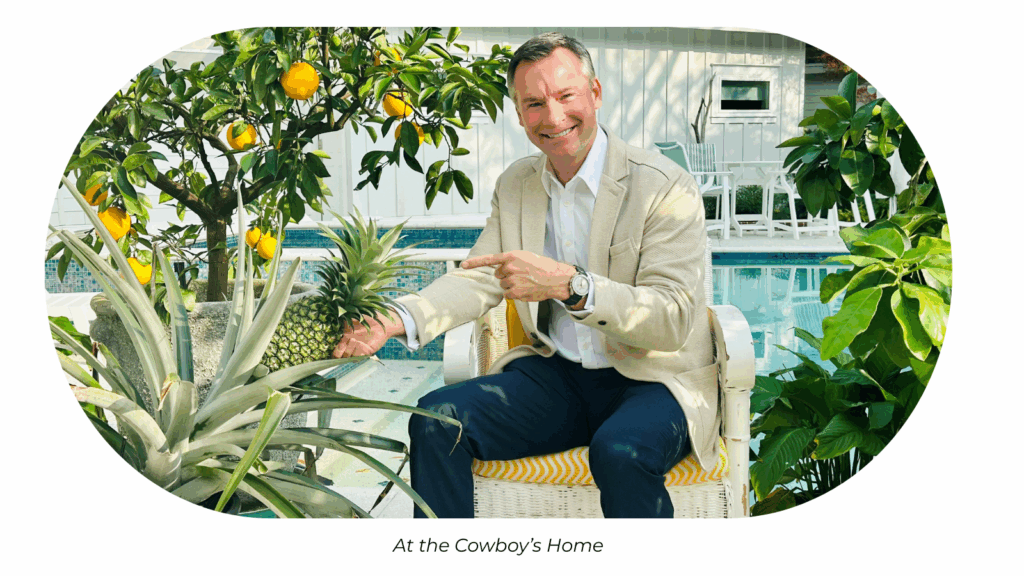
By the summer of 2014, the one shoot I planted in the ground was still green, but it was the same size as the day I planted it. Only two shoots from the palms planted in pots survived. I removed them and planted them in a place where they would get plenty of sunshine and room to grow. Now, I had three shoots in the ground. I followed the Cowboy’s instructions exactly as given to me: Plant, water occasionally, leave them alone and wait. For several years, nothing happened above ground. Zero growth. The top half was green and looked the same as the day they were planted. When I would talk with the Cowboy, he would ask me, “How are your trees doing?” I shared with him I was following his instructions and being patient. He smiled and always said something like “they’ll grow, just leave them alone and wait and see”. Reinforced by the Cowboy’s words, I stayed the course.
Palm trees have fascinated me over the years and the experiment of growing them, almost from scratch, has been an exciting adventure. For starters, only 50% of sabal palm seedlings survive the first year. Next, the first ten or more years of a sabal palm’s life, little to no trunk growth may be experienced. The trunk will only grow once a nutrient rich, deep root system is in place allowing vertical growth to occur. Growth slows significantly when the temperature is around 50 degrees, and the tree will completely stop growing during colder weather. Palms trees grow around warm coastal areas and are often the last standing trees under the harshest of conditions. Palms naturally drop seeds which will germinate under the right conditions and produce offshoots of the original tree. Depending on where they are planted, sabals typically grow 6-12 inches per year.10
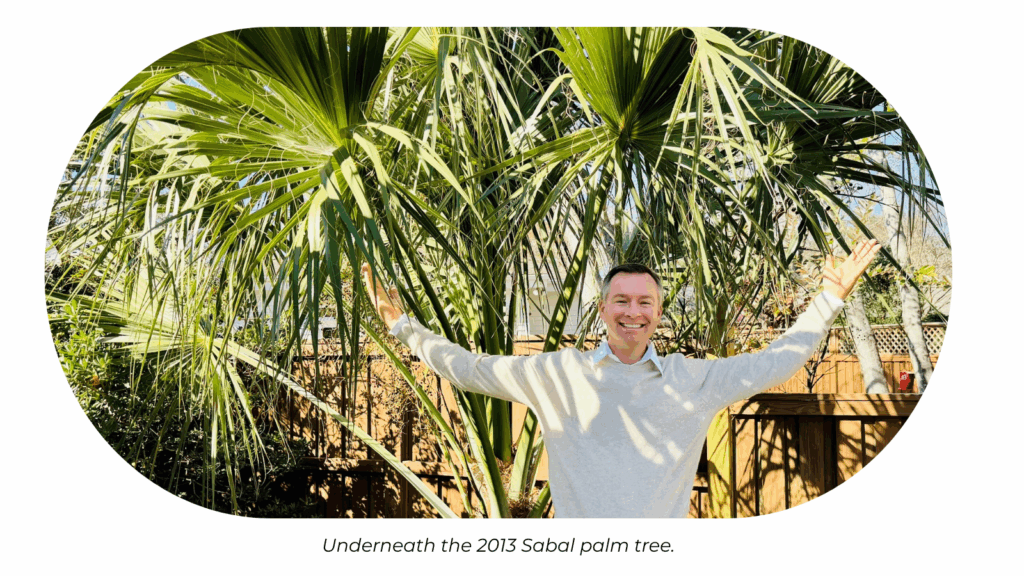
As I write this letter to you, the three Sabal palm shoots planted in 2013 and 2014 are thriving. The trunks are three feet tall, and the fronds extend 11 feet in the air and 11 feet wide. The Cowboy was right!
In closing, I would like to share a few thoughtful reflections shaping our future. Information is king and the companies who attain, employ and deploy it effectively and efficiently will prevail. Those who cannot become extinct. The rules of technology, culture and company building are being rewritten daily. You are familiar with the companies leading the charge because you own them in your retirement and investment accounts. Names such as Apple, Amazon, Microsoft, Google, Meta (Facebook), Nvidia (the largest company in the world as of this writing-valued at more than $4.5 trillion), Broadcom, Proctor and Gamble, JP Morgan, IBM, Oracle, Netflix and the list continues. These companies and other publicly and non-publicly traded companies are pouring hundreds of billions of dollars into research and implementation of paradigm-shifting technologies. Their efforts are being funded by the companies themselves, governments around the world and other strategic partners. Currently, the United States leads by a wide margin on all fronts and the root system for future growth is being built, exponentially.
The United States has started or become an early adopter of all innovative cycles taken place in the modern world. It is a hallmark of the capitalistic American society. Three major technological revolutions have spanned the last 50 years: the personal computer started in the mid-1970s, the internet began in the 1980’s, and now computers and the internet are synergizing with Artificial Intelligence (AI) to create the Age of Technology. AI’s computing power is currently doubling every 10-12 months, twice as fast as normal. It helps protect our country and is used in our classrooms, banks, healthcare, travel, entertainment and every screen we look at. It is everywhere, and we teach it by how we live daily. Though it might not be comfortable, accepting and adapting to it will be important to thrive in the future.
The most often publicly communicated concern now is Artificial Intelligence’s impact on the job market, which is as fluid and dynamic as it has ever been. Yes, some jobs will become obsolete. AI will also create jobs and unlock opportunities and possibilities beyond our current comprehension. Humans have irreplaceable qualities. The challenge will be for us to gain and apply knowledge differently than we have in the past and then humanize it to remain relevant in the workforce. This process will take time and patience, just like the Cowboy’s instructions to me on how to grow palm trees.
I will continue to encourage you to view your investments as having ownership in the best companies in the world because you do. Sound bites from worldwide influential sources will persist to posture and position preferred narratives. These occurrences can temporarily disrupt the financial markets, therefore our account balances. For the long-term investor, it is an opportunity to do nothing or make additional investments if you have the funds, both of which are the opposite of what human emotion is begging us to do. Tune out the noise, stay positive and remain focused on your visions, goals and dreams. This is where the art and science of living abundantly flourish. We are on this journey together and if anything changes in your life or you ever want to have a conversation, please let me know. You enjoy 100% open lines of communication with me, and I promise to reach out to you if we need to alter course.
Let us remember trees do not grow to the sky. However, nature usually takes over if we plant the right trees, in the right soil, give them plenty of sunshine and room to grow. These trees will likely withstand powerful storms and eventually drop seeds which produce new trees and positively affect the world. This is the essence of our work together.
I feel incredibly fortunate for you to welcome me into your family and for you to be a part of mine. Thank you for making me feel this way. I hope your 2025 holiday season is the best ever, and I look forward to a prosperous 2026!
Best,
Tim Evans, CFP® CLTC
Founder
An extra special thank you to Deidre Carney, the Curator of the Wrightsville Beach Museum of History.
1Blockade runners of the American Civil War-Wikipedia
2Gullahheritage.wordpress.com
3National Hurricane Center (NHC), National Oceanic and Atmospheric Administration (NOAA), World Meteorological Organization (WMO)
4www.weather.gov/about/radar
5www.aoml.noaa.gov/ftp/hrd/dorst/reade/NortonBio.pdf-National Oceanic and Atmospheric Administration-Grady Norton: Hurricane Forecaster and Communicator Extraordinaire
6North Carolina’s Deadliest Hurricane-WRAL Documentary
7WRAL News
8https://www.nhc.noaa.gov/data/tcr/AL062018_Florence.pdf
9Town of Wrightsville Beach
10https://edis.ifas.ufl.edu/publication/ST575/pdf